Wednesday, October 20, 2010

Another Winner from our Belle Province!

I have  a confession to make, when I was a little girl I hated cheese!  Even my Mom's homemade Macaroni and Cheese wasn't a favorite of mine.  I can empathize when little ones come into the store and cringe when I offer them a sample because that was me a few years ago - OK, maybe just a little more than a few years ago, but just a little!  And it wasn't such a long time ago that I thought that I didn't like blue cheese....until one time I selected a little morsel from a cheese tray that was delicious.  I went back for more and then when no one was looking, took the whole piece!  It was later that I discovered that this was indeed blue cheese and once I got the tang, well suffice it to say that I haven't looked back. 

Today's topic is the magnificent blue cheese from a small cheese maker in Québec, Fromagerie du Presbytère just east of Drummondville.    Le Bleu d'Elizabeth is the second cheese to come from Fromagerie du Presbytère and won a gold medal in 2009 at the Québec Seléction Caseus awards!  This says a lot about the quality of cheese making and the skill of the cheese makers, brothers Jean and Dominique Morin who are fourth generation farmers of this land.  Le Bleu d'Elizabeth is a farmhouse cheese, meaning that the milk produced from the farm's mixed herd of Holstein's, Jersey's and a few Canadienne is the sole source of the milk used to make the cheese not only that but the farm has been organic for the past 20 years.  The cheese itself is aged two to three months which produces a milder blue although the brothers are busy aging some of the cheese for 12 months for those who like a stronger blue kick.

Le Bleu d'Elizabeth is a raw milk cheese with full flavours of sour cream, butter and salt all balanced in a creamy paste that is melt-in-your-mouth delicious and not a bitter note to spoil the experience!  To all of you who proclaim not to like blue cheese, this one may very well change your mind.  Pair it with a glass of Cidre Glacé available at the LCBO and why not try  Le Bleu d'Elizabeth  ($8.00/100g) with an aged Comté ($7.70/100g) on your cheeseboard - a bit of Old World paired with the New!

It is of note that another cheese produced by Fromagerie du Presbytère, Louis d'Or won the gold medal at the Seléction Caseus in 2010 - 2 years in a row!  We will be watching to see what masterpiece comes from this cheese maker in the future.  And you can be sure that I will be adding Louis D'Or to the shopping list for "C'est Cheese Please!"

Bon Appetit!

Thursday, September 30, 2010

And Now For Something Quite Different!

Looking for something quite unique for your cheese board this weekend?  Well, this just might do the trick - Tomme Marc de Raisin.  This is a tomme cheese that has been aged in the "marc" which is the residuals leftover from making red wine.  So you ask me, what perchance is a "Tomme Cheese" Wendi?  It is, I reply a pressed, unheated cheese.  Let me explain a little more.  We all know that pasteurized milk is milk that has been heated to 65 degrees Celsius for a period of not less than 30 minutes.  At this temperature all bacteria, both good and bad are killed.  Raw milk cheeses are for the most part partially heated, below the temperature for pasteurization and must be aged for at least 60 days prior to being sold, this allows the good bacteria in the cheese to survive adding a special flavour to the cheese which cannot be replicated in pasteurized cheeses.  Tomme's fall into this second category.  The milk is heated to approximately 31-37 degrees Celsius at which point rennet is added to the milk to hasten the separation of the curd from the whey.  The curds are then hand pressed into molds.  The cheese is matured in caves where the natural "micro flora" (naturally occurring good bacteria) does its thing to the cheese et Voila, Tomme.  In the case of Tomme Marc de Raisin, the aging process is done under a thick coating of the marc which imparts the flavours of the wine to the cheese - a wonderful cheese to enjoy with one of those "big" reds that we hear so much about.  Oh, and don't try to eat the marc (I know that you will try it!), brush it off and serve the cheese on a bed of the marc for a WOW presentation - the marc is not just the dried grapes but also includes a lot of "roughage" too - twigs, bits of grapevine - which don't lend themselves to the pleasant enjoyment of the cheese.  Come into "C'est Cheese Please!" where Tomme Marc de Raisin is in stock at $8.00/100g

Bon Appetit!

Friday, August 27, 2010

Girls, Girls, Girls......See The Buff Girls In All Their Glory!

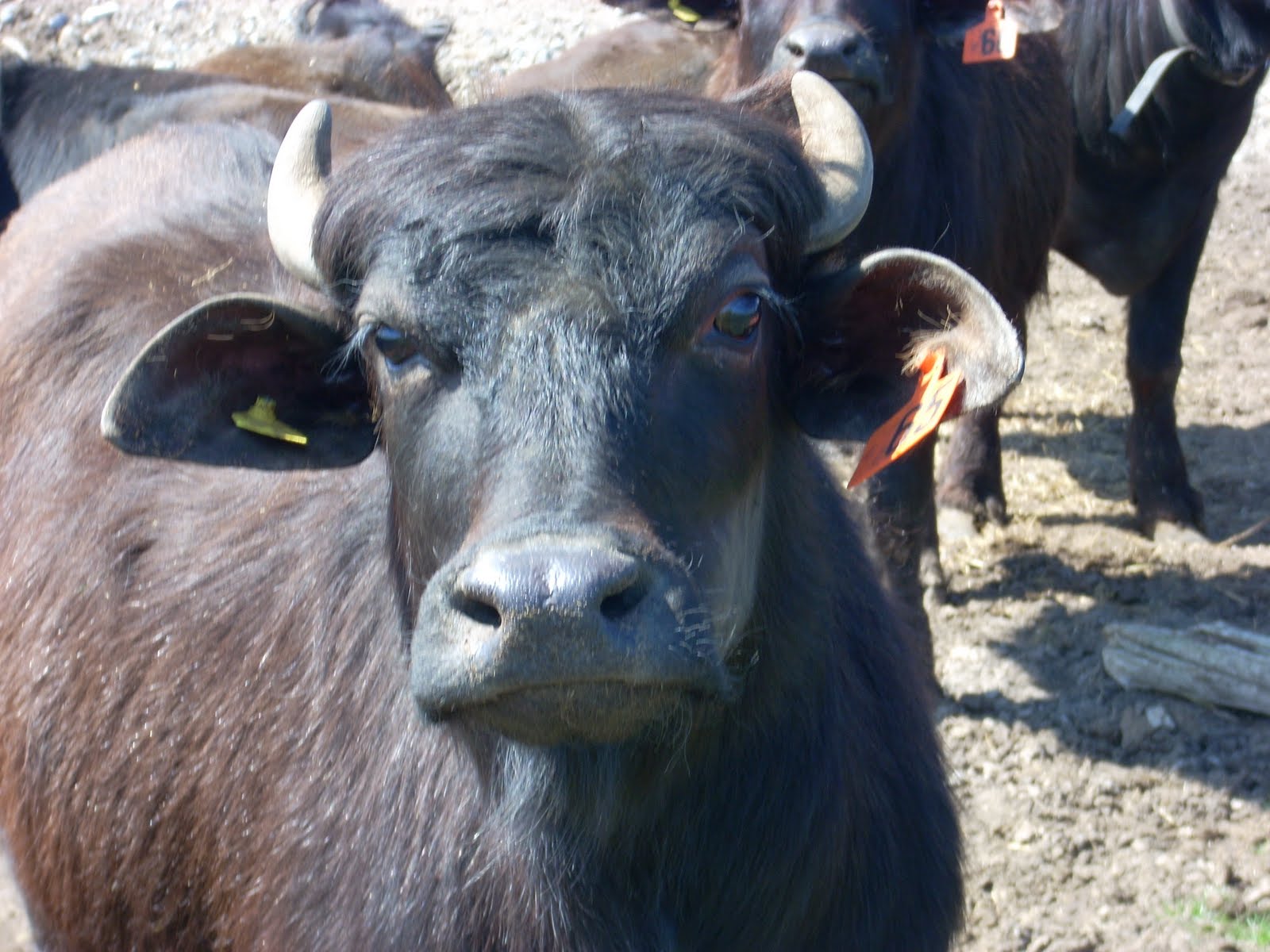
Well, maybe not what you were expecting but ain't they cute?  These fabulous four-legged beauties are the Water Buffalo that produce the milk which is made into the Buffalo Mozzarella available here at "C'est Cheese Please!"   To your left is Hannah, below her is Peanut.

Buffalo Mozzarella as well a Burrata are relatively new cheeses in terms of availability.  As these are fresh cheeses, they were flown in from Italy and that reflected in the high cost.  Now with milking herds of Water Buffalo here in Ontario, these fabulous cheeses are easier to come by at a much better price.  Buffalo Mozzarella has a creamy texture and a mild flavour that is perfect for salads and of course, Margherita Pizza.

As a nod to the hot weather that we have been experiencing, why not serve a salad tonight?  Take your Caprese Salad up a notch by grilling a couple of peaches on the BBQ.  On your platter, place a bed of Arrugala. slice up some Heirloom Tomatoes, the grilled peaches, chop some fresh Basil and drizzle with your Extra Virgin Olive Oil and Balsamic Vinegar and  pour yourself something white, cold and crisp.

 So why don't you mooove on over to "C'est Cheese Please!" for a container of the Buffalo Mozzarella  or Burrata that these girls have been busy grazing away to produce?

From Hannah, Peanut and Wendy (she's the little one!).....


Bon Appétit!

Thursday, August 19, 2010

Eat, Pray, Love or is it Eat, Love, Pray?

The current "Chick Flick" is "Eat, Pray, Love" chronicling the quest to find oneself that Elizabeth Gilbert embarks on.  Her first point of call is Italy where she regales us with her non-stop feast.  I understand this well as I spent 6 months in Italy (Milano to be exact) studying footwear design back when there was a Canadian footwear industry.  During my time there, I marvelled at the way that the Italians revered food - it wasn't just something that you did 3 times a day often in a car with the paper wrappers sort of spread out in hopes that the juices would be contained whilst you downed the article to be consumed (hate to give it the status of actual food) as quickly as possible.  No, the Italians would frown most emphatically at that notion and in a somewhat disgusted tone make reference to "Americanos".  No, this is a land that celebrates the meal and from the very simple to the complex, every dish is afforded the respect that it deserves.  I remember sitting in a park in the late September sun at the noon break (which by the way goes from noon hour until 3 pm - yes, really!  And EVERYTHING closes.) enjoying a slice of what I now know to be focaccia, dimpled and tossed with caramelized onion and olive oil which I got just out of the oven from a little store just up the road from the school I was attending and a fresh tomato from the fruit and vegetable store and thinking that I had died and gone to heaven. 

So today I just got in a little somethin', somethin' that is pretty special.  Along with the parmigiano reggiano and pecorinos that Italy is so famous for, Italians love soft, fresh cheese.  We are probably most familiar with ricotta which we have become accustomed to adding to our lasagna but there is a world of wonderful soft cheeses - La Tur, Burrata, fresh mozzarella or  Bocaccini are just a few that come to mind.  And this one, Stracchino which is the one that I will focus on today.

Stacchino is a derivative of the word "stracca" which means quite literally tired as in cows which have been moved up and down the slopes of the Alps.  Apparently the milk that these poor tired cows produce is richer in fats and more acidic which gives this soft, silky custard-like cheese its characteristically delicate, tangy flavour.  It comes from the northern part of Italy, Lombardy, of which Milano is its capital!  These cheeses do not have a long shelf life and therefore up to now, getting them to Canada quickly has been problematic and VERY EXPENSIVE!  But now an Italian family, no doubt pining for these delicacies, has started to produce them here in Canada!  In stock today at "C'est Cheese Please!" is Stracchino in a 200g container for the bargain price of $8.79, ready to spread on a crusty bread with your favorite fruit preserve or maybe served in this traditional way, spread on focaccia.

Focaccia al Formaggio

500g durum wheat flour
5 tablespoons of extra virgin olive oil
Salt

Make a mound of the flour on your work table and scoop a well in the middle.  Pour 4 tablespoons of extra virgin olive oil into the well, a small ladle of warm water and 2 healthy pinches of salt.  Work this mixture into a dough and knead until it is soft, smooth and elastic.  Cover the dough with plastic wrap and let stand for 1 hour.

Preheat your oven to 360F and divide the dough into 2 pieces.  Roll out to a thin disk the size of the baking sheet that you are using (a 12 - 14 inch pizza pan should be right).  Lightly oil the pan and spread the first sheet of dough on it.  Roughly (with your hands) shred the cheese and dot the dough with it.  Spread the second sheet of dough over everything and roll the edges up and around to form a rim that seals the two sheets.  You can add a decorative look by pressing the tines of a fork around the edge.  Puncture the top sheet so that the moisture can escape and bake for about 15 minutes until the top is golden.

Now, go find that tomato and Eat, Love and Pray for more!

I found a really great video that shows how to make Focaccia al Formaggio except that it is in Italian, but regardless I think that you will see the method quite well and this guy is such an expert kneader - watch his his hands so expertly kneading and then throwing the dough around to shape it - WOW!  I will post that on the "C'est Cheese Please Facebook Page"

Buon Appetito!

Thursday, July 29, 2010

I've Got The Blues

This past April, I wrote about a beautiful Swiss-style cheese called "Mont St. Benoit" which is produced by the monks at the Abbaye de Saint-Benoit-du-lac located in the Eastern Townships of Québec.  I thought that with the upcoming Blues Festival in Kitchener (August 5th - 8th), I would write about another of the great cheeses that come from the Abbaye - Bleu Bénédictin.  This is one of two blue cheeses that come from the Abbaye, the other being Ermite.  The difference between the two comes from the length of time that the cheese is allowed to mature in the ripening room,.  Ermite has a ripening time of 5 weeks at which time the natural rind is washed off whereas Bénédictin is allowed to mature for 5 months and the natural mould rind is kept on the cheese. 

It is perhaps helpful to understand the process that is used to make blue cheese in order to better appreciate the differences in the end product.  Blue cheese is really a form of controlled spoilage.  Early in the cheese making process, the cheese maker introduces the "Penicillium Roqueforti" spores into the milk.  Once the cheese has been formed, long, thin needles are inserted into the cheese allowing air to enter the cheese through the tunnels that are created.  The result is the growth of the familiar mould  or veining.  The mould breaks down the fats and proteins in the cheese and the longer that this process is allowed to occur, the more intense the flavour that develops and the smoother the texture of the cheese becomes.  Blue cheese because of the tunnelling, ages from the inside out, the opposite of say for example, a cheddar which ages from the outside in.

As we would expect from this understanding of the cheese making process, Bénédictin has a more pronounced flavour and a smoother, creamier texture than its younger sibling, Ermite.  In 2006, Bénédictin won the Canadian Grand Prix and is in stock at "C'est Cheese Please!" $4.85 per 100g.   Enjoy this beautiful cheese with a soupcon of Cidre Glace, also from Québec.   Cidre Glace is the fabulous Iced Cider from Pinnacle and is the perfect accompaniment to blue cheese especially a blue cheese from La Belle Province.  I guarantee it will have you singing the blues, the blue cheese blues!

Bon Appétit!

Friday, July 16, 2010

Is Cheese Art?

"...nature is still a mystery, you never see it whole.  It's like me, always slipping away."  Jean-Paul Riopelle 1923-2002

Beginning as he described himself as a "Sunday Painter", Riopelle developed into one of our national treasurers, an absract painter who used large varieties of different coloured paint applied thickly to the canvas with a trowel.  In the years from 1942-45, he became part of a group in Paris known as the "Automatistes" known for their spontaneous method of painting.  In his later life, he divided his time between two homes in Québec, one of which was in  Isles-aux-Grues, a little island in the St. Lawrence east of Québec City.  This little island is only 4.5 miles long and 1.5 miles wide and boasts a population of 120 people!  From this tiny island comes this fabulous cheese named for an equally fabulous artist.  Riopelle, the cheese, is a raw milk triple cream with a bloomy rind.  It melts in your mouth leaving behind tastes of hazelnut and mushroom with a buttery paste.  In 2004, Riopelle won the Canadian Cheese Grand Prix, a testament to the dedication of the cheesemaker to produce a cheese worthy of the Riopelle name.  When asked to give his name to this outstanding cheese, Jean Paul Riopelle made a few conditions.  Firstly, that the cheese be of the highest quality and that $1 from each wheel of cheese sold go towards a fund to help educate the young people of the Isles-aux-Grues.  He also provided the original painting which graces the outside of the wheel.  He died in March of 2002 without having tasted his namesake cheese.

Is cheese art?  In the case of Riopelle, the answer is " Mais Oui!"

Bon Appetit!

Thursday, July 8, 2010

The King of Cheeses

"...but for the odor which is felt in the back of the mouth, the sensation of taste would be but obtuse and imperfect"     Jean Anthelme Brillat-Savarin 1755-1826.                  
Époisse de Bourgogne, named for the village in Cote-d'Or where it is made in France, is one of those quintessential French cheeses whose presence on the cheeseboard makes itself known long before one sets eyes upon it.  Yes, it smells, but as is often said "Get over it!" because once you do, you will discover a cheese that beneath its reddy-orange rind is decadently creamy.  Spoon it onto a hearty bread or for a really French approach, serve it as the dessert course with raisin bread and toast to life with a glass of Burgundy wine "Santé"!

Époisse is made in a very complicated process, the cows must have grazed on the grasses in the meadows of Burgundy for 3 months.  Once the cheese is formed, it undergoes a complicated series of washes with salt water, rain water and finally Marc de Bourgogne (a local spirit) two or three times a week until it is ready.  It is an AOC protected cheese which means that all the time-honoured preparations must be followed in order to be called "Époisse".  This was a favorite cheese of Napoleon and Brillat-Savarin (the original "foodie" of the 1700's whose book "Physiologie du Gout", 1825 set the stage for the appreciation of the meal.  He is remembered for his famous quote "Tell me what you eat, and I will tell you what you are.")  And it can be a favorite of your's too as it is in stock at "C'est Cheese Please!"

There are a lot of new and old favorites that are here waiting for the chance to thrill you.  Cendrillon, the 2009 World Champion from Québec, Cendré du Lune (Triple Cream with an ash coating), Paillot de Chèvre, Comté along many other goodies are here in the display cases.  And be sure to print off the coupon that was in last week's edition for $2 off your purchase of $15 or more - good until July 31st!

Bon Appetit!